

UX Research | Information Architecture | Design & Implementation Strategy
Building a Vision for the Association of American Universities' Digital Strategy
01
OVERVIEW
Context
Client
The Association of American Universities (AAU)
Duration
June 2024 - December 2024
My Role
As Lead Experience Designer & Researcher, I collaborated with Digital Marketing, Developer, Visual Designer, and Project Management teams to conduct an in-depth research project and develop strategic recommendations for AAU’s website redesign. The specific work I led included:
Tools Used


Project Strategy
01
-
Research Strategy
-
Design & Implementation Strategy
-
Scope of Work Development
Client Research
02
-
Pre-Project Questionnaire
-
Discovery Sessions
-
Survey & Interview Analysis
Audience Research
03
-
Interviews & Focus Groups
-
Audience Survey
-
Survey & Interview Analysis
Information Architecture
04
-
Website Content Audit
-
Card Sorting
Site Mapping -
A/B Tree Testing
-
Card Sort & Tree Test Analysis
Approach
A research-driven UX framework
This case study outlines the discovery process using a research-driven UX framework. It should be noted that in execution the process evolved to be less linear than detailed below.
📅 Plan
Defined objectives, research questions, and methodology (e.g., surveys, interviews, usability testing).
🔍 Explore
Conducted qualitative and quantitative research (e.g., stakeholder interviews, content audits, audience analysis).
📊 Synthesize
Analyzed findings, identify patterns, and define key insights.
⭐️ Recommend
Developed research-backed recommendations and strategies for implementation.
About AAU
Championing research and innovation in higher education
The Association of American Universities (AAU) represents 71 leading research universities in the U.S. and Canada. It advocates for federal policies that support research, education, and innovation, driving initiatives that strengthen higher education and highlight the societal impact of academic research.
AAU engaged Mighty Citizen to conduct an in-depth research and discovery project with the ultimate goal of redesigning its website to enhance the user experience, streamline internal workflows, and strengthen its presence with target audiences.


Problem
AAU's website undermines its value
While AAU is recognized as a leader in higher education advocacy, its website makes it difficult for audiences to understand its priorities and find key information—limiting engagement and undermining its impact.
Solution
A strategy to elevate AAU’s digital presence and impact
Through in-depth research we developed strategic recommendations focused on:
✔ Branding & Messaging: Clarify AAU’s mission and improve content engagement
✔ Content Management: Streamline workflows and improve information access
✔ Navigation & Search: Enhance content discoverability and usability
These recommendations formed the foundation of the project’s next phase, a comprehensive website redesign, in order to ensure design decisions were informed by research and to position AAU’s website as a more accessible, authoritative, and engaging resource.
02
CLIENT RESEARCH
Pre-Project Questionnaire
Establishing a baseline
The PPQ served as an anonymous, structured research tool to gather input from 8 AAU staff members directly involved in the project. The questionnaire captured perceptions, goals, concerns, and expectations across multiple focus areas, including:
-
Primary and secondary audiences for the website redesign
-
AAU’s primary goals for engaging new audiences with its website
-
Perceptions and misperceptions about AAU’s brand
-
Competitor and peer benchmarking
-
Current website pain points and opportunities for improvement
-
Examples of effective websites AAU stakeholders admire
💡 Impact: By collecting diverse perspectives, the PPQ helped identify common themes across departments while also surfacing key differences in goals and expectations between departments and team members. These findings informed the agenda for the Discovery Session.


Discovery Session
AAU wants to improve its content strategy and findability
Following the survey analysis, I led a Discovery Session with AAU’s leadership from Government Relations, Communications, IT, and Digital Media teams who had participated in the PPQ. The session aimed to align stakeholders on project objectives, audience priorities, website pain points, and key themes from the PPQ. High-level takeaways included:
-
Need to Balance Internal and External Audiences: The site was designed for members, but staff recognized the need for clearer access to advocacy efforts for policymakers and the public.
-
Website Navigation Creates Challenges: Inconsistent organization made it difficult for staff to find information.
-
Lack of Advocacy Storytelling: AAU’s website features the work of members but fails to communicate its own mission, priorities, and impact.
-
Inefficient Content Management: Manual workflows and inconsistent updates created inefficiencies, prompting interest in automation for improved consistency and streamlined processes.
💡 Impact: Ultimately, these findings directly shaped the audience research plan and would later be leveraged for scope additions to the research plan.
03
AUDIENCE RESEARCH
Audience Research Strategy
A multi-phase approach to uncover audience insights
To ensure AAU’s website redesign would meet audience needs, I developed a multi-phase research strategy that included conducting audience interviews and focus groups to gather qualitative insights and an audience survey providing us with the quantitative data to validate findings and refine recommendations. This research aimed to answer key questions:
-
How do target audiences use AAU’s website?
-
What challenges do users face when navigating the site and finding relevant information?
-
How can AAU’s advocacy work be communicated more effectively through the website?
-
What content formats and messaging resonate most with target audiences?
Target Audiences
Helping AAU determine high priority target audiences
In presenting my research plan to the AAU team, a key recommendation I made was to narrow the focus to 3 key target audiences (instead of the original list of 10) who would directly influence AAU’s ability to achieve its advocacy and organizational goals. Ultimately AAU agreed to prioritize:
-
Government Officials & Policymakers: Includes members of the legislative and executive branches.
-
AAU Members: University presidents, chancellors, provosts, and deans.
-
AAU Member Representatives: Faculty, professors, and researchers engaged in AAU projects but without direct AAU member logins.
Audience Research Strategy Adjustments
Pivoting approach based on feedback and challenges
Initially, I planned to conduct 8 one-hour interviews across target audience groups as part of my research plan, however, AAU was hesitant to request an hour of their contacts' time. AAU later also struggled with recruiting their contacts who were representative of the target audiences. Some key adjustments I made to address these issues were:
-
Shortened interviews to 30 minutes to increase participation.
-
Added focus groups to gather additional perspectives within limited time constraints.
-
Pivoted audience targeting by including former government officials and senior research officers from member universities as surrogates for harder-to-reach audiences.
💡 Impact: Having flexibility with the client allowed AAU to connect me with 5 former government officials and 6 senior research officers for interviews and focus groups allowing me to gather key insights that would inform the recommendations for the website redesign.
Audience Interview Findings
Interviews reinforce content and site usability challenges
Through analysis of the audience research I learned that there were critical gaps in how AAU’s target audiences interact with and view its website and resources. Key findings highlighted issues with content visibility, navigation, search functionality, and advocacy impact. Some insights reinforced client research, while others provided new perspectives that directly shaped our strategic recommendations.
-
Audiences have limited visibility of AAU’s advocacy efforts.
-
Site navigation & content overload make content hard to find.
-
The internal site search is ineffective
-
Real-time updates would help with advocacy efforts.
-
Login based content restrictions make it hard to access content.
-
Policymakers need district-specific information over broad data for their work.
-
Audiences struggle to identify the right AAU contact for support and response times are inconsistent.
“There’s a ton of information on the site, which is great in theory, but it’s overwhelming. You don’t always know where to start. I usually just Google what I need because it’s faster than searching on the site.”
- AAU Member
Survey Findings
Survey data supports interview insights
To understand if the qualitative insights from interviews applied to broader audiences, we conducted a survey to quantify audience perceptions of AAU’s website and content. The survey received 25 responses and the results reinforced key themes from interviews and focus groups, strengthening the case for streamlining content, improving navigation, and enhancing advocacy communication.
From the survey we learned:
The smallest portion of respondents felt that it was easy to find content on AAU’s website.


We also learned:
44% of respondents specified that AAU’s website has “difficult menu navigation” and “poor search functionality.”
Survey results also confirmed the need for concise, digestible content formats:
-
100% preferred executive summaries & fact sheets.
-
78% valued data visualizations and infographics.
-
50% found policy memos and talking points useful.
📝 Note: In other words, short form content is king! This would eventually support insights from the Content and Digital Marketing Audits that producing over 18 separate documents types for audiences might not be the best use of time.
04
WEBSITE CONTENT AUDIT
Content Audit Overview
Content audit uncovers design, usability, and structural issues
Following audience research, I conducted a website content audit of 100+ pages of AAU’s site which revealed major design, usability, and structural issues preventing users from efficiently accessing information. From branding inconsistencies to overwhelming content volume and broken site architecture, our findings highlighted the need for a more strategic, user-centered approach to content management.
From the content audit we learned:
A lack of visual and web design consistency
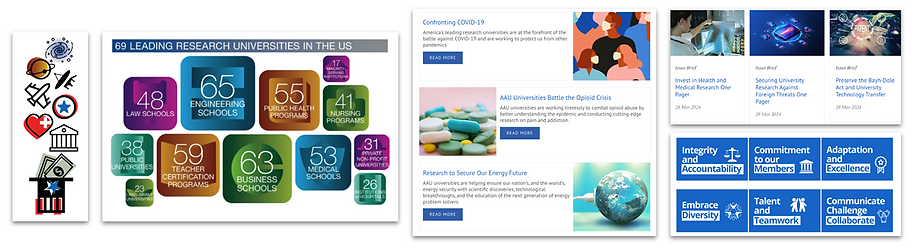
Visual elements such as graphics, photography, and color palettes look like they are coming from different organizations. This can distract and confuse audiences.

Page elements such as sidebars and card modules also vary significantly across the site, adding to a disjointed site experience.

CTAs lack consistent styles and placement or are nonexistent, making it unclear what next steps users should take on many pages.

Several pages use graphics and text that fail to meet size and contrast standards. This makes them hard to read and may impact accessibility compliance.

A lack of proper subheadings makes content harder for readers to skim, negatively impacts accessibility, and reduces SEO effectiveness.
Additionally:
Content and Digital Marketing Audits uncovered inconsistencies in the URL structure of the site
The current website's page hierarchy is unclear. For example, many pages fall under "Issues," which is not included in the top-level navigation.

Content and Digital Marketing Audits also uncovered that AAU’s site has an overly complex navigation and tagging system.
It seems that the top-level navigation section categories and subsections are being mixed with departments, subjects, and fiscal years.
• Example - In the main menu, “Export Controls” is a subsection of “Science and Security,” but in the “Key Issues” library they are both listed in the dropdown menu at the same level in what looks like an undifferentiated list.

Digital Marketing & Content Audit Findings
Using data to gain client buy-in on content reduction
The content audit and discussions with the project team revealed that AAU’s excessive content volume hindered usability and SEO. When we floated the idea to AAU of deleting content, leadership hesitated, fearing older content remained valuable due to the cyclical nature of their work. To make a data-driven case, I collaborated with our Digital Marketing specialist to analyze page visits and engagement data, uncovering that 6,000+ pages had fewer than 10 views in the past 3 years (nearly half of the 13,000+ indexed pages).
In addition to the insights gathered we also offered a multi-layered content reduction plan, not just one that focused on deletion.
-
Consolidate redundant or outdated content
-
Archive low-traffic but historically significant resources
-
Delete content with little engagement or long-term value
💡 Impact: When given additional data and a structured approach to reducing content, AAU leadership shifted from resistance to full support. This validated our research-driven approach and ensured the redesign would prioritize usability over content preservation.
05
INFORMATION ARCHITECTURE
Information Architecture Scope Addition
Expanding research scope to address navigation issues
Because navigation issues emerged as a key pain point in audience research I advocated to expand the research scope to include Information Architecture (IA) research using card sorting and A/B tree testing to refine the site structure before redesign.
This research strategy aimed to:
-
Identify how users naturally categorize and search for content using a card sort activity
-
Compare navigation structures via a A/B tree testing as informed by the card sort to determine the most intuitive organization
-
Ensure the site serves both AAU members and external audiences effectively
Card Sorting & Tree Test Research Approach
IA research aimed at understanding mental models
Phase 1: Card Sorting using Optimal Workshop (30 Participants)
-
Open Card Sorting: Participants grouped 40 AAU content topics into categories they created.
-
Open Ended Response: Asked additional follow up questions about their process for card sorting.
Phase 2: A/B Tree Testing also using Optimal Workshop (18 Participants)
-
Tasks to Locate Content: Participants completed 12 tasks to locate key content, with success rates, task times, and missteps analyzed.
-
Open Ended Response: Asked additional follow up questions to understand if the navigation topics aligned with expectations.
Card Sorting & Tree Testing Analysis
Audiences prefer a topic-focused navigation structure
The card sort revealed that most categories created by participants were topic-focused and organized by major themes rather than audience or task-based groups. This insight shaped our A/B tree test, comparing topics & advocacy area-based navigation versus navigation structured around AAU’s internal departments.
Test A top-level navigation:
-
About AAU
-
Federal Advocacy
-
Campus Initiatives
-
Member Resources
-
News
Test B top-level navigation:
-
About AAU
-
Member Universities
-
Government Relations & Advocacy
-
Research & Campus Policy
-
News
-
Resources for Members
⭐ ️Results: The average success rate for all tasks on Tree Test A was 71% versus Tree Test B which had a lower success rate of 64%.
Tree Test A aligned better with how members generally think about AAU’s content
When participants were asked how well the organization of topics of each tree test matched how they generally think about AAU’s content and resources, Tree Test A performed better.

Tree Testing also revealed the importance of an interconnected site structure
When asked about dividing AAU’s content into federal advocacy/policy and campus content:
-
50% agreed
-
28% somewhat agreed (but need cross linking)
-
22% disagreed
“The way it was organized looked pretty good, though I'd recommend linking in federal policy priorities on the campus pages where relevant, and vice versa.” - AAU Member
📝 Note: Typically we think of sitemaps as having a top down visual, like a tree’s roots but, AAU’s sitemap is likely going to need to be horizontal and interconnect and will continue to utilizing tagging.
06
STRATEGIC RECOMMENDATIONS
Cross-functional Collaboration
Facilitating cross-functional collaboration to share ideas
To align the cross-functional teams on recommendations we would make for AAU’s website redesign, I led a cross-functional collaboration session using Miro. These efforts helped the team to share key research findings, brainstorm on recommendations, and create a loose structure for the Strategic Brief.

Strategic Brief Overview
A research-driven vision for AAU’s digital future
The Strategic Brief synthesizes UX research, SEO analysis, and development insights to guide AAU’s website redesign. Rooted in data and stakeholder feedback, it aligns project goals with user needs to enhance usability, engagement, and advocacy impact.
The recommendations provide a roadmap for improving content accessibility, streamlining workflows, and strengthening AAU’s leadership in higher education policy and advocacy.

Branding & Messaging
Enhance awareness of and engagement with AAU
🟢 Goal: Strengthen AAU’s identity & improve engagement through clear, consistent messaging.
✔ Develop a Messaging Platform: To unify communications, written content, and branding across all touch points for clarity, accessibility, & audience relevance.
✔ Clarify AAU’s Mission & Values: Standardize messaging (Mission, Vision, Just Cause, Benefits Delivered).
✔ Execute an Integrated Marketing Strategy: Improve reach with targeted campaigns & audience segmentation.
✔ Establish a Design System: Create consistent visuals, layouts & CTAs to reinforce brand identity.
💡 Why This Matters: A unified brand voice and improved messaging increase audience trust, engagement, and advocacy effectiveness.
Content Management
Support efficient website updates and archiving
🟢 Goal: Streamline workflows, improve content governance, and reduce redundant material.
✔ Rebuild Site in Craft CMS: Flexible, scalable, and user friendly role-based content management system.
✔ Consolidate & Archive Content: Consolidate low-traffic pages, archive historical content, and reduce redundancies.
✔ Develop a Governance Strategy: Define approval workflows & establish content guidelines to maintain consistency.
✔ Simplify Site Categories: Focus on 6-7 top level categories & consolidate document types to improve content organization and findability.
💡 Why This Matters: A streamlined CMS and governance model enable faster updates, better user experience, and sustainable content strategy.
Navigation & Search
Help staff and audiences find information quickly
🟢 Goal: Improve content discoverability through simplified navigation and enhanced search.
✔ Restructure Information Architecture: Use topic-based navigation based on card sorting & tree testing insights.
✔ Address SEO Issues: Standardize URL structures, resolve broken links, and improve metadata.
✔ Enhance Search Functionality: Integrate advanced tools (Algolia/AddSearch) with personalized results.
✔ Develop a Centralized Resource Library: Consolidate materials under one searchable hub with filters.
✔ Conduct Usability Testing: Validate new navigation & search with AAU members & external audiences.
💡 Why This Matters: Improved navigation & search ensures users can find critical information quickly & intuitively, reducing friction, and increasing engagement.
Results & Next Steps
Laying the foundation for design and implementation
With data-backed recommendations in place, AAU approved the strategy, setting the stage for the website redesign and implementation phase. While the redesign has yet to take place, this research-driven approach ensures that future development will be grounded in user insights, content accessibility, and advocacy effectiveness.
By prioritizing usability, content clarity, and intuitive navigation, AAU is now equipped with a clear roadmap to enhance its digital presence, better engage stakeholders, and reinforce its leadership in higher education advocacy. The insights from this discovery phase will continue to inform design and implementation decisions, ensuring a user-centric, scalable, and strategically aligned digital experience.
💡 Final Thought: This case study underscores the value of UX research in shaping digital strategy before design and implementation begin in order to inform decision making and drive long-term success.

Apple Maps Case Study
CFPB Case Study
